Always Learning
Module Overview
Farm Environment Award-winners Don and Kirsten Watson talk with Farmstrong about what it takes to run a high-functioning farm.
Earlier this year Don and Kirsten Watson were named the 2026 Auckland Regional Supreme Winners at the Ballance Farm Environment Awards. Run by the New Zealand Farm Environment Trust, the awards celebrate excellence in sustainable farming and growing.
“It was probably the pinnacle of our career,” says Kirsten. “We’re pretty stoked. It’s a reflection of the work put in by Don and myself and the team over many years.”
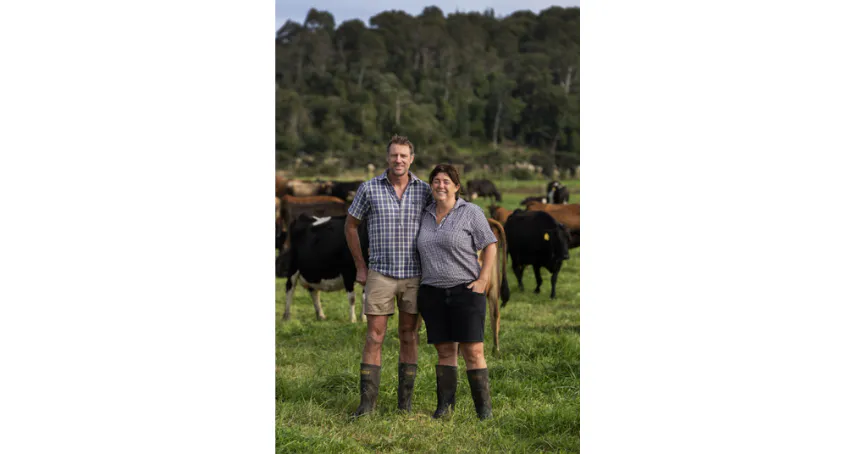
Don and Kirsten have a 220-hectare dairy farm on the South Head Peninsula on the Kaipara Harbour, northwest of Auckland. They run 300 cows with split calving in autumn and spring.
The judges were impressed, commending them for lifting pasture production, cutting nitrogen use, utilising virtual fencing and restoring local wetlands. The Award is recognition of just how far they’ve come in adopting an innovative, technology-driven approach to farming.
Love of farming
Don and Kirsten were both raised on farms and love the farming life. They love working outdoors and working with animals. Don particularly likes problem-solving and improving farm systems.
“For a goal and task-oriented person, there’s always a challenge with farming,” says Don. “You’re always learning. There’s very limited status quo. When you’re on the path of improving sustainability and biological efficiency, the challenge is there every day.”
Don and Kirsten came through the share-milking pathway to farm ownership, purchasing the farm in 2017. Back then they were milking 1,700 cows on 650 hectares and had a four-hour milking time.
“We learned a lot about stress and fatigue and work overload from that experience and made improvements,” says Kirsten. “These days we have quite a few staff which allows us to manage high-stress periods. We know how not to burn staff out and not burn ourselves out. We don’t push the system to the level that it breaks.
“I think long milking times is probably a great stressor on farms because it ties up labour in the sheds for long periods of time. That puts stress on all the other work that needs to be done.”
The Watsons have used modern technology to ease the load in many aspects of farming.
“We have a short milking time now. We’ve got a 32-bale rotary with ACRS and auto-drafting and it takes roughly an hour to an hour 30. It’s a one-person job.”
The Halter pasture and management system is another example of technology helping farmers to achieve improved results with less time input.
Wellbeing focus
Don and Kirsten are well aware that to have a sustainable farming operation they need to keep themselves well. They are firm believers in the Five Ways to Wellbeing.
“We listen to the Farmstrong ambassadors and have read the Farmstrong books,” says Don. “It’s good that the wellbeing message is getting out. The farmer has to function right to sustain a good farming operation.”
But Don admits it can be hard to live the wellbeing message in practice.
“If you’re task-oriented and you actually love your job with a passion, sometimes it’s really difficult to separate yourself from the job. It’s very difficult when you live and breathe it.
“A lot of farmers are hands-on, task-oriented. We get enjoyment out of seeing things done, ticking things off, getting things achieved. When you are feeling overwhelmed with what’s to be done, it’s really hard to follow the five pillars of wellbeing.”
These days Don and Kirsten have some ingrained habits that help to balance their lives and build personal resilience.
“We take regular time off and go and watch our kids play rugby. We like to follow the NPC competition,” says Kirsten. “I have refereed every weekend in rugby season. We’re a bit rugby mad. There’s a really strong community around the rugby club that we are part of.”
They make a point of keeping in touch with old friends. And living on the Kaipara, there’s always the chance for some snapper fishing or deer hunting.
“We’ve also got Muriwai Beach nearby so we might shoot off there for half a day on the weekend. We now try and do something off-farm every weekend,” says Kirsten.
Giving back
Both Don and Kirsten believe in giving back to the farming community.
Says Kirsten: “Giving back to the industry is really important for us. For example, Don helps other farmers with problems when they crop up. He does a lot of that. And I’m on the LIC (Livestock Improvement Corporation) shareholder reference group. I like to fit that kind of thing into my day. Giving back to industry makes me feel good.”
Don and Kirsten are also very committed to training young people and giving them a taste of the industry. Being a dairy assistant suits young people, says Kirsten.
“We have a lot of talented young people in our area looking for employment. We are really proud to impart our knowledge and showcase farming as a career. Both the young women who currently work for us are heading off to further their skills and knowledge, one at university and the other at vet school. So we’ll be looking for more young people going forward.”
Kirsten’s message to newcomers to the industry is to keep learning and make the effort to get connected with others in the industry.
“Learn as much as you can, both practical skills and technical knowledge. The technical knowledge required for farming these days is quite high-level. There’s so much information available now for young people to learn.
“The connection part is also really important. You have to make an effort to connect and get to know people. Join Young Farmers and other rural groups, meet up with your ITO people, go to the discussion groups.
“The more you talk to farmers, the more you’ll connect and learn and grow. It’s cumulative over time. It’s hard to begin with but the dairy industry is super-welcoming. People are happy to share their knowledge. They want to see young people grow. It’s all there for young people to tap into.”
Big tests
Kirsten and Don have had to contend with some big tests of their resilience in their farming careers. The two that spring to mind are Cyclone Gabrielle and a significant snow in 2016. Both events taught them that you have to know where the risks are in your business.
“We know that we need to have a generator,” says Don. “We know we need to have feed for the animals, we need staff capability, food on hand, water, back-up plans. When we had the snow we went 30 days without power. You have to have a plan for how you are going to deal with a situation like that.
“When there’s a civil emergency like Cyclone Gabrielle, you can’t expect anyone to turn up for two to three days. Communications are down, roads are closed. You have to get into survival mode and help yourself.”
And that’s what farming communities are good at, says Don.
“The community met up with tractors and chainsaws, checked on people in the area and cleared the road enough to get one lane operational. If anyone had a medical emergency, we could drive them to town. We did it as locals.”
Resilience is critical to riding the ups and downs of farming, says Kirsten, and continuing to learn is critical to building resilience.
“We’ve lived through civil emergencies. We’ve learned lessons from each of them and made improvements. But there’s always more to learn.’