Keeping On Track
Module Overview
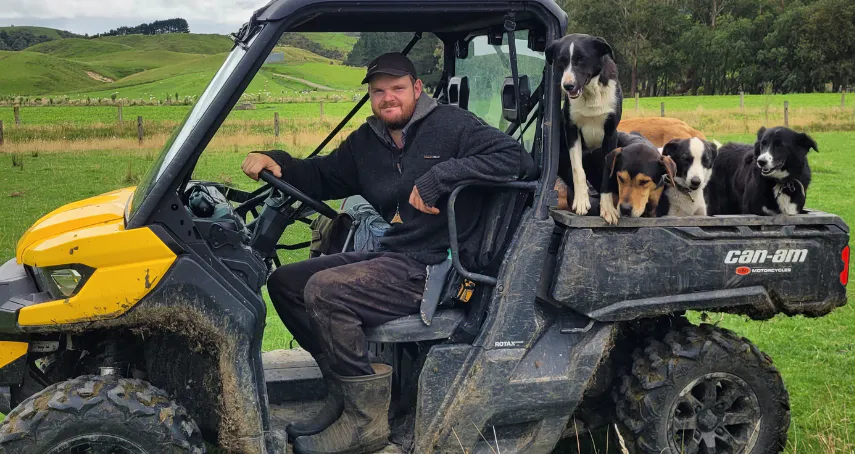
Kaden van Gaalen farms on the Pahiatua Track and helps to run the Tararua Young Farmers Club. He shares how he navigates the ups and down of farming and stays well.
Tell us about your farming operation?
We’re predominantly sheep breeding, but we do a bit of dairy grazing and bull finishing as well. We’re on 280 ha and have been here for about 18 months.
How did you get into that role?
I was in Wairarapa and saw the job come up. It was close to both my family and my wife’s family, and we’ve got two young kids, so we thought, why not?
What do you enjoy about farming?
The main thing is I just enjoy working outside. It does rain a lot here, so that sometimes can dampen things a bit, but I still just enjoy being outside and being able to work with my dogs and the stock. You’re not just doing the same thing every day either. Each day is a little bit different.
What’s the plan looking ahead?
The end goal is to one day have my own farm, but in the interim, the aim is to scale up to a bigger management job and achieve some type of equity partnership. That’s where things are at.
What are the main challenges for you on farm?
Sometimes it gets very wet here, but I can’t complain. We don’t really have to ever worry about drying out like others do through summer. But sometimes you just get over working in the rain all the time. It’s nice to see that yellow thing up there in the sky sometimes.
What about the workload? Do you get a good balance between the farm and family life?
If you asked my wife, she’d probably say no, but as a whole, it’s been pretty good. I enjoy the flexibility of working alone. For example, if we’ve got a kids’ sport event on in the afternoon, I can knock off a bit early and go along and then I’ll come home, have dinner, and then go out and finish the last bit that I need to get done on farm.
On the other hand, because it’s just me working here, if I decide not to do something then it doesn’t get done. Sometimes the time still gets away on me a bit too. I’ve been caught out a few times at how long things actually take when you’re doing them by yourself [laughs].
Do you have any help at all?
Yes, at really peak times like weaning and docking I get in staff.
Does the isolation of working alone ever get to you?
I definitely noticed it when I first moved here, because I didn’t really know anyone in the area, and I’d always worked with other people. It was a bit different working by yourself, but I don’t mind it now. I’ve got to know neighbours, we chat during the week on social media, or you’ll bump into them when you’re on the boundary. A lot of the other farmers around here are one or two-man operations as well.
Who’s your main support person?
My wife would definitely be my number one supporter. I’m close with my family and they’re only an hour away and I’ve also become good mates with quite a few of the neighbours. I jumped aboard with the Young Farmers last year too which is a great way to boost to that social connection.
Can you share a challenging time you’ve been through?
Not long after I started here, we got quite severe liver fluke in the ewes. I’d only just started so I thought: ‘Oh no, everything’s gone wrong, what have I done.’ That was a big thing to deal with.
What helped you get through?
It was about taking a step back, doing my research, talking to people, and getting my head around things a bit more. Accepting that I wasn’t not going to be able to fix the problem to 100% as soon as it had happened. It was a slow ball game, but eventually, we came out the other side ok.
What about days when nothing seems to go right? How do you handle them?
For me, it’s about stepping aside for five minutes and taking a deep breath. Or sometimes I’ll go home and have an early lunch just to have a breather for a bit and refresh mentally.
Or if I’m out mustering in the hills, it’s about taking a few minutes to sit there and look at what you’re actually working on and the view that you have. Telling yourself, ‘Hey, it’s actually quite a nice spot I’ve got here.’ I think sometimes in farming you can get so focused on getting jobs done that you forget to stand back and smell the flowers.
Do you and the family get off farm much for breaks?
We probably didn’t take as much of Christmas off as we’d have liked, but we had weaning coming up. Once weaning and shearing are out the sway more will be possible. We generally try and get away a few times a year.
How does that help your farming?
Even a long weekend gives you the chance for a bit of a reset and recharge.
What about the basics of performance like nutrition, sleep, hydration? How do they factor in your thinking?
I think that sleep is definitely a big one and nutrition as well. You’ve definitely got to eat right if you want to get through a long day and not go into a lull. I always try to carry a couple of big bottles of water on the bike too, so I keep drinking. It’s the same as the food, if you go a few hours without water and it’s muggy and hot, you just feel lethargic and don’t really want to do anything.
What does being Farmstrong mean to you?
To me, being Farmstrong is about making sure that you look after yourself and others around you.
How would you sum up the way you approach the various challenges of farming?
I don’t think there’s anything wrong with stress per se. It’s just how much of it you put on yourself. If you didn’t have any stress in your life, it would probably be pretty mundane. Doing something that’s a decent challenge is a chance to broaden your skills, set some goals and really go for it. That’s why we’re doing what we’re doing.
Farmstrong is a nationwide, rural wellbeing programme that helps people manage the ups and downs of farming and growing. Last year, 20,000 farmers attributed an increase in their wellbeing to the programme. For free, farmer-to-farmer tools and resources head to www.farmstrong.co.nz.